










General Projects
EXPLORATORY TRIP TO CAMEROON REGARDING AFRICAN UNIVERSITY
Two faculty members at Ball State University, Dr. John Motloch and Scott Truex and Dr. Martha Ndako Baiyee of Eastern Michigan University made a one-week visit (Sunday, July 15 to Saturday, July 22) to Cameroon regarding the African University project. The objectives of the trip were to see the land reserved for African University in Tali, Cameroon and meet the people associated with the African University initiative in Cameroon in order to build a relationship that promotes the development of African University. The first stop of this exploratory trip was at the Baiyee Family Residence in Mutengene where Mrs. Sarah Agbor Baiyee welcomed the visitors to Cameroon. African University Foundation collaborated in planning the trip.
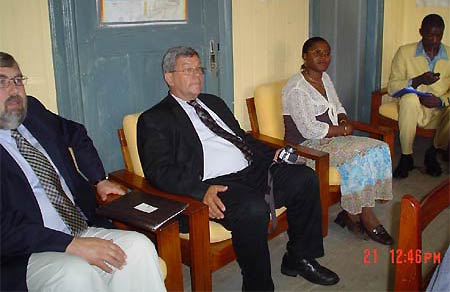
|
| A summative evaluation meeting during the exploratory trip. (From left to right: Mr. Scott Truex, Dr. John Motloch, Dr. Martha Ndako Baiyee and Mr. Amah Taboko.) |
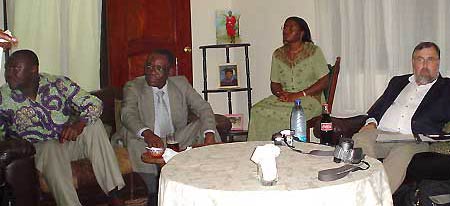
|
| In the Baiyee Family Residence, Mutengene, Cameroon. (From left to right: Mr. Chris Enow Oben, Dr. Martha Ndako Baiyee and Mr. Scott Truex.) |
During the trip they held meetings with government officials in the Ministry of Higher Education in Yaounde, the Minister of Forests and Wildlife, His Excellency Hilman Achuo Egbe, South West Provincial Delegate of Land Tenure and State Property, Mr. Emmanuel Ebune, The Mayor of Tinto Rural Council, Mr. Oscar Enow Baiyee. The Governor of the Southwest Province, Louis Eyeya Zanga, promised collaboration, saying the project would create more institutions in the country.
Visit to Tali
Mr. Scott Truex and Dr. John Motloch, His Excellency Enow Tanjong, Board Chairman of African University Foundation in Cameroon, Mr. Charles Amah Taboko, Barrister Benjamin Agbor Enow and a host of Tali elites living in other Cameroonian cities arrived in the evening of Monday, July 17, 2006. They were received by HRH Orock Baiyee, Reverend Apostle Henry Egbemba Betang, Vice Chairman, African University Foundation in Cameroon, Members of the Tali Traditional Council and interested inhabitants of Tali. In his capacity as Vice Board Chairman, Reverend Apostle Betang welcomed the visitors to his residence and wished them a happy stay in Tali.
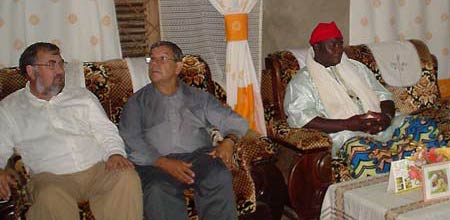
|
| At Reverend Apostle Betang's residence in Tali. |
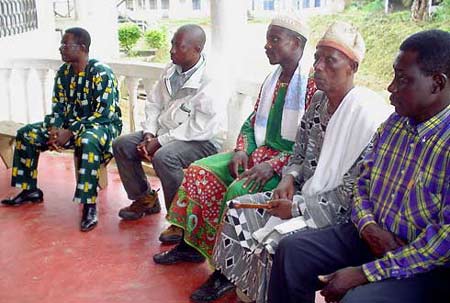
|
| Residents of Tali. |
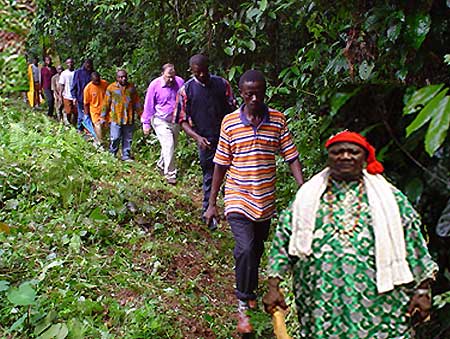
The following day was filled will activities including a visit to the future campus of African University, Tali, Cameroon and a meeting in the townhall. The townhall meeting was marked by cultural festivities such as the "Ekpe Dance." There was excitement and jubilation on this important day.
|
| Visiting the future campus of African University. |
|
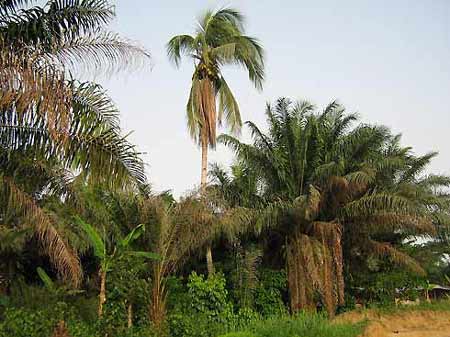
| Tali palm trees |
Speaking in the Kenyang Language, HRH Orock Tabi Baiyee declared the two American guests as Honorary Sons of Tali, and by extension, sons of the Ndifaw Clan. Reverend Apostle Betang read a Welcome Address on behalf of the Tali. He mentioned some historical landmarks about Tali, especially its being the birth place of education in the Upper Banayng Subdivision, Manyu Division, South West Province; the base where Malcolm Ruel settled and conducted research about the Banyangs/Cross River People; reiterated the significant contribution of the people to provide the land for African University, Tali, Cameroon. Malcolm Ruel published his research findings in a book entitled "Leopards and Leaders: Constitutional Politics Among a Cross River People."
HRH Simon Orock Tabi Baiyee of Tali I, in his speech during the trip said the people of Tali are very hardworking and deserving of the proposed African University. He stressed that Tali has many natural resources such timber, sand and gravel, necessary to building the new university. Chief Baiyee further said that "We also have enough manpower needed to carry out the work and the Traditional Council is ready for any financial contributions necessary for the construction of African University."
|
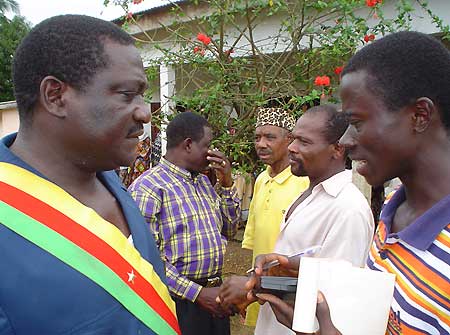
| Mayor of Tinto, at left, wearing Cameroonian flag sash. |
|
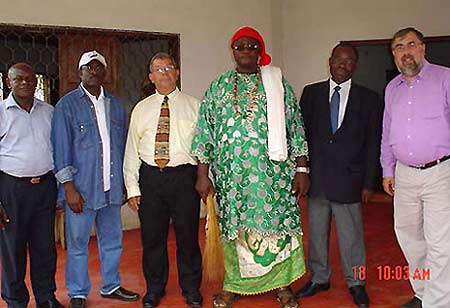
| From left to right: Mr. Stephen Nforson, Mr. Enow Oben, Dr. John Motloch, HRH Orock Baiyee, His Excellency Enow Tanjong, and Mr. Scott Truex in Tali. |
The Mayor of the Tinto Rural Council, Mr. Oscar Enow Baiyee, remarked the Tali has abundant land needed for the construction of African University, and with 59 villages in Upper Banyang Subdivision, the population could provide adequate resources needed by the new university. He said that out of the 59 villages in the Upper Banyang Subdivision, Manyu Division, Tali I, is the most active in terms of development. The Mayor further stated "I had my primary education in Tali I and I believe it is a suitable place for the African University project." He promised complete support of the African University project.
His Excellency Enow Tanjong, chairman of African University Foundation in Cameroon, said that it is time to establish a new university in this rural area. He stated that "This new university project will benefit not only Manyu Division, but also Cameroon and Africa as a whole."
Barrister Benjamin Agbor Enow, Legal Counsel of African University Foundation in Cameroon, said the choice of Tali was the result of its education foundation. He remarked "Tali I had one of the first schools in Manyu Division built in 1921. People left neighboring towns and villages such as Mamfe, Fontem and even Nigeria to attend school in Tali. Some highly placed officials in the government received their basic education in Tali. This choice will go a long way to improve the educational spirit in Tali."
Speaking about an objective of the trip to Tali, Scott Truex said, "We are going to Tali to visit the countryside and to see the land which has been reserved for the building African University." The Tali I Traditional Council has reserved 10 square miles for the construction of African University in Tali. Mr. Truex also expressed his delight at the warm welcome which the people of Tali had given them. He acknowledged that such an enthusiastic reception and the provision of land were proof that the people of Tali are willing and capable of having African University.
Acknowledgments
Thanks to the West Foundation and Moore Foundation located in Indianapolis, Indiana, USA for their financial support.